MRKONJIĆ GRAD TO LAUNCH REGIONALLY BRANDED RAKIJA
“Mrkonjić Grad sits on millions of liters of rakija!” Such headlines occasionally appeared in the media about a decade ago. Recently, however, stories about the municipality and its traditional fruit brandy have become increasingly common.
While
it is difficult to determine the exact size of the region’s “rakija reserves,”
one thing is certain—Mrkonjić Grad is home to some of the last remaining
orchards of the renowned Požegača plum. This traditional plum variety, along
with other fruits grown in the area, tends to produce higher yields here than
in many other parts of the Krajina.
The
municipality is also known for hosting one of the oldest exhibitions and
evaluations of rakija in both the Republic of Srpska and Bosnia and
Herzegovina. The event, led by renowned expert Ninoslav Nikičević, is
traditionally held each year during the Aranđelovdan Fair.
Building a Brand
Recognizing
these resources and the potential they represent, local stakeholders have
launched an initiative to standardize, brand and strategically position
Mrkonjić rakija on the domestic market for the first time.
The
project is led by the Development Agency of Mrkonjić Grad, headed by Dijana
Eremija, while implementation is being carried out by the Krajina Agricultural
Cluster.
“In
the first phase of the project, we identified several of the most prominent and
award-winning rakija producers from the municipality. They will serve as the
foundation of this initiative, and together we will begin concrete activities
related to the standardization and branding of our rakija,” Eremija explained.
Production Conditions and Cooperative Organization
A few
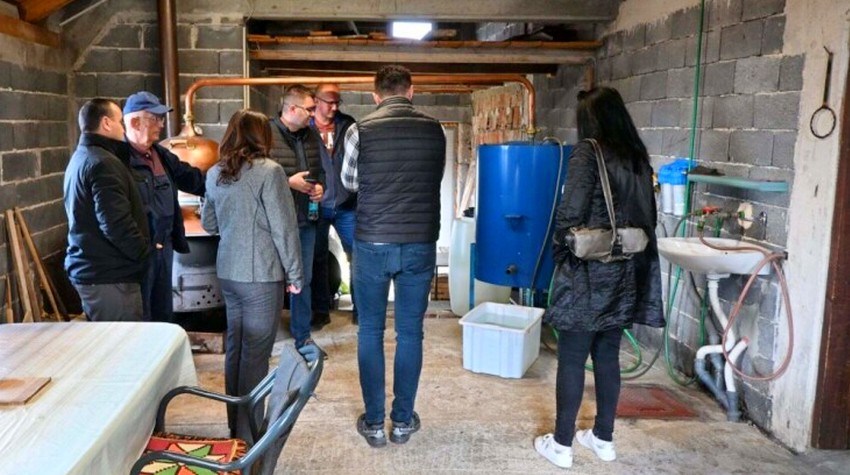
days ago, representatives of the project visited five selected households to
assess their production conditions and market readiness, particularly from a
technological standpoint. The visits also provided an opportunity to discuss
the most effective way for producers to organize themselves.
“We
agreed with our selected hosts to establish an agricultural cooperative,” said
Miloš Galić, manager of the Krajina Agricultural Cluster. “Through our
discussions we concluded that the cooperative model best reflects the
traditional, household-based approach to rakija production that we want to
preserve, while avoiding any association with large-scale industrialization.”
New Methodology and ‘Umbrella’ Brand
Internal
relations and production standards within the group will be regulated through
the “PGS” standard, a methodology in which producers collectively define
business rules, technological standards and quality requirements, while also
conducting their own monitoring and corrective measures.
Since
this methodology is not widely used in the country, it also represents an
interesting marketing approach.
“Our
plan is to design, define and launch the first ‘umbrella’ brand on the domestic
rakija market,” explained agromarketing expert Petar Ninić, a member of the
project’s expert team. “Under a single name, it will bring together the most
important rakija producers from the municipality of Mrkonjić Grad. At the same
time, the joint brand will preserve the unique identity and story of each
individual household.”

Join our
Viber Community
TRAVELING BY CAMPERVAN FOR THE FIRST TIME? HERE’S WHAT YOU SHOULD KNOW BEFORE YOU GO

NEW RAIL LINK BETWEEN REPUBLIKA SRPSKA AND SERBIA: DAILY TRAIN SERVICE FROM ZVORNIK TO BELGRADE
‘DRŽAVNI POSAO’ CREW FILMS NEW PROJECT IN TREBINJE
SEE SRPSKA RECEIVES CHARTER FROM BANJA LUKA TOURIST ORGANIZATION

GALIJA TO CELEBRATE MAJOR ANNIVERSARY IN BANJA LUKA
SEE SRPSKA RECEIVES CHARTER FROM BANJA LUKA TOURIST ORGANIZATION
NEW RAIL LINK BETWEEN REPUBLIKA SRPSKA AND SERBIA: DAILY TRAIN SERVICE FROM ZVORNIK TO BELGRADE

BANJA LUKA BOOK FAIR 2026 OPENS TODAY

DAYS OF SEMBERIJA IN AUSTRIA: CULTURE, TRADITION AND LOCAL PRODUCTS PRESENTED TO AUSTRIAN AUDIENCES

FROM EUROPEAN STAGES TO HER HOMETOWN: JOVANA RALJIĆ BRINGS VIVALDI TO BANJALUKA


 The situation at the border crossings