WORLD CUP STORIES MORE INCREDIBLE THAN FOOTBALL ITSELF
Behind the goals, trophies, and legendary champions lie stories that have shaped FIFA World Cup history just as powerfully as the matches themselves.
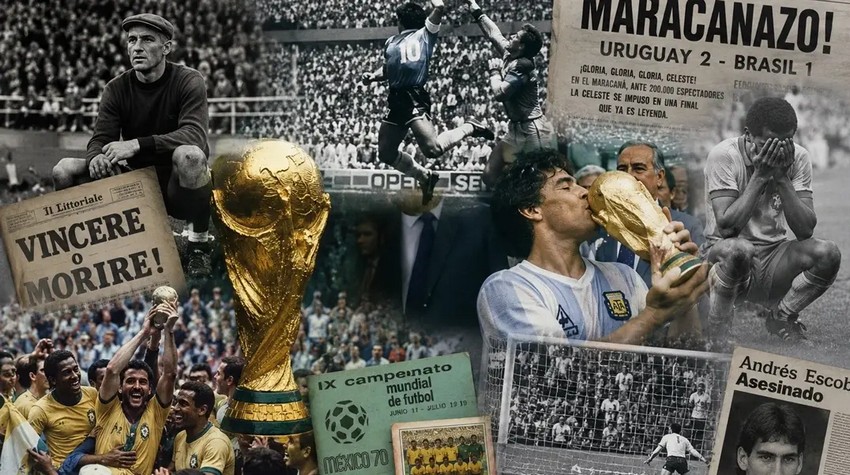
From
political pressure and controversial decisions to human tragedies, collecting
crazes, and moments that became part of global pop culture, the World Cup has
always been much more than a football tournament.
THE POLICEMAN WHO HELPED SCORE A WORLD CUP GOAL
The
first FIFA World Cup was held in Uruguay in 1930. Yugoslavia reached the
semi-finals, where it faced the host nation in front of a passionate home
crowd.
The
Yugoslav side stunned Uruguay by taking the lead through Đorđe Vujadinović, but
the hosts soon equalized and eventually secured a convincing 6-1 victory. One
of the tournament’s most famous anecdotes involves Uruguay’s second goal.
During the attack, a police officer reportedly returned the ball to play after
it had gone out, allowing Juan Anselmo to score. The referee allowed the goal
to stand, while Yugoslavia also saw a legitimate goal disallowed, according to
eyewitness accounts.
The
final itself featured another remarkable story. Uruguayan player Héctor Castro,
who had lost one arm as a child, not only competed at the highest level but
also scored during the tournament and helped his country win the world title.
THE TELEGRAM THAT ENTERED FOOTBALL HISTORY
At the
1938 World Cup, Italy once again stood at the center of attention, along with
the country’s fascist leader Benito Mussolini.
Before
the final against Hungary, Mussolini allegedly sent a telegram to the Italian
players carrying the chilling message: “Vincere o morire!” – “Win or die!”
Led by
stars such as Giuseppe Meazza, Giovanni Ferrari, and Silvio Piola, Italy chose
victory. The Azzurri defeated Hungary 4-2 and became the first national team to
successfully defend a World Cup title. Because World War II prevented
tournaments from being held in 1942 and 1946, Italy remained world champion for
an extraordinary 12 years.
THE DAY BRAZIL FELL SILENT
On
July 16, 1950, more than 200,000 spectators packed Rio de Janeiro’s Maracanã
Stadium expecting to witness Brazil’s first World Cup triumph.
The
hosts needed only a draw against Uruguay, and celebrations had already begun.
Newspapers declared Brazil champions in advance, gold medals had been prepared,
and officials were ready for a historic coronation.
Instead,
Uruguay delivered one of the greatest shocks in sports history. Inspired by
captain Obdulio Varela, the visitors overturned the score and won 2-1. The
stadium fell into an eerie silence, while the defeat was perceived as a
national tragedy throughout Brazil.
The
match became known as the “Maracanazo,” forever symbolizing the day football’s
most confident nation saw its dream collapse before its eyes.
A MYSTERY THAT HAS LASTED SIX DECADES
England’s
1966 World Cup triumph remains one of football’s most debated achievements.
In the
final against West Germany, Geoff Hurst scored what became one of the most
controversial goals ever recorded. His powerful shot struck the crossbar and
bounced down near the goal line before returning to play.
After
consulting assistant referee Tofiq Bahramov, referee Gottfried Dienst awarded
the goal. England eventually won 4-2 after extra time, securing its only World
Cup title.
Yet
one question remains unanswered even today: did the ball completely cross the
line? Despite decades of analysis, technology, and debate, no definitive answer
has satisfied everyone, making the Wembley final one of the sport’s enduring
mysteries.
THE PANINI REVOLUTION THAT CAPTURED GENERATIONS
The
1970 World Cup in Mexico changed football culture forever.
It
introduced the first Panini sticker album, launching a collecting phenomenon
that continues to fascinate generations of fans around the world.
The
tournament also marked the debut of yellow and red cards, giving referees a
universal disciplinary system. Ironically, despite the innovation, no player
was sent off during the competition.
Mexico
1970 was also the first World Cup to feature a major opening ceremony. Before
the opening match between Mexico and the Soviet Union, 50,000 colorful balloons
were released into the sky, beginning a tradition that continues to this day.
THE HAND OF GOD AND THE GOAL OF THE CENTURY
Few
World Cup performances have matched the brilliance of Diego Maradona at Mexico
1986.
In the
quarter-final against England, played only four years after the Falklands War,
Maradona first scored the infamous “Hand of God” goal, using his hand to direct
the ball into the net without the officials noticing.
Four
minutes later came a moment of pure football genius.
Collecting
the ball in his own half, Maradona dribbled past multiple English players,
rounded the goalkeeper, and scored a breathtaking goal later voted by FIFA as
the “Goal of the Century.”
Argentina
won 2-1 and eventually lifted the World Cup trophy, while those two goals
became symbols of one of the greatest individual performances ever seen on
football’s biggest stage.
THE TRAGEDY THAT SHOCKED THE FOOTBALL WORLD
The
1994 World Cup in the United States is remembered not only for Brazil’s fourth
world title but also for one of football’s darkest stories.
Colombian
defender Andrés Escobar scored an own goal in a crucial match against the host
nation, contributing to Colombia’s elimination from the tournament.
Just
five days after returning home, Escobar was murdered in Medellín.
According
to reports at the time, the gunman repeatedly shouted “Goal!” while firing,
cruelly referencing the own goal that had brought international attention to
the player. The case fueled widespread speculation about links to gambling
losses and criminal organizations, although many questions remained unanswered.
Escobar’s
death became a tragic symbol of a period when football, violence, and organized
crime intersected in devastating ways. More than three decades later, it remains
one of the most heartbreaking stories ever associated with the FIFA World Cup.
These
extraordinary tales prove that the World Cup is far more than a sporting
competition. It is a stage where politics, culture, heroism, controversy,
triumph, and tragedy have repeatedly collided, creating stories that often
outlive the matches themselves.

Join our
Viber Community

NEW GENERATION OF STUDENT THEATRE MEMBERS TAKES THE STAGE

AUTUMN FRUITS AND HONEY FESTIVAL COMES TO BANJALUKA

DEJAN KOKANOVIĆ CONQUERS 336 KM THROUGH THE ITALIAN ALPS

HOMEMADE AJVAR - A TASTE OF TRADITION

OKTOBERFEST KICKS OFF IN MUNICH, EXPECTING 6.5 MILLION VISITORS
DEJAN KOKANOVIĆ CONQUERS 336 KM THROUGH THE ITALIAN ALPS

DERVENTA BRINGS ITS PAST TO LIFE: 3D FORTRESS AND VIRTUAL TOUR OF THE CITY

HERZEGOVINIAN EMBROIDERY IN THE HANDS OF NEW GENERATIONS
OKTOBERFEST KICKS OFF IN MUNICH, EXPECTING 6.5 MILLION VISITORS

SPANISH TRAVEL WRITER DISCOVERS THE GREEN SIDE OF BANJA LUKA


 The situation at the border crossings