WHO IS GARY RABINE, THE MAN WHO PLANS TO TRANSFORM HERZEGOVINA’S TRANSPORT NETWORK?
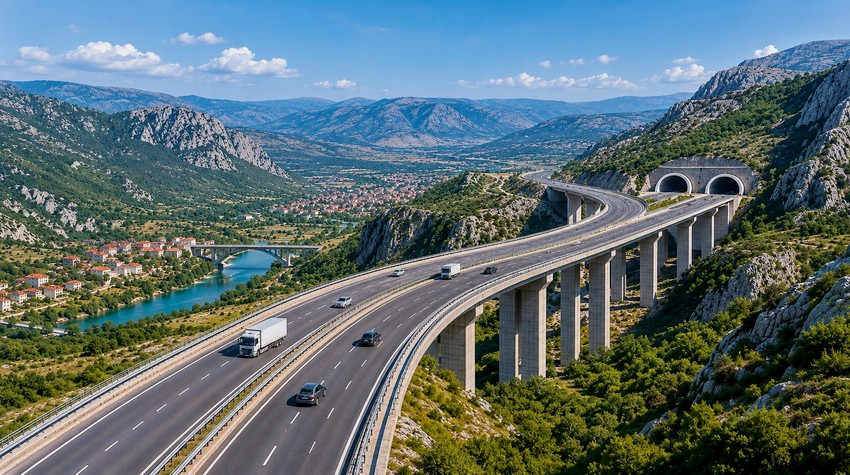
The signing of a memorandum of understanding between the Republic of Srpska and representatives of American companies has brought new attention to one of the most ambitious infrastructure projects in the Western Balkans — the Adriatic-Ionian Motorway. At the center of the story is American entrepreneur Gary Rabine, whose company is now being linked to the future motorway section connecting Stolac and Trebinje.
The
memorandum was signed in Banja Luka at the end of May by Republika Srpska
Minister of Transport and Communications Zoran Stevanović and representatives
of U.S. companies. One of the main goals highlighted during the signing was the
realization of the motorway route that would pass through Herzegovina as part
of the future Adriatic-Ionian highway corridor through Bosnia and Herzegovina.
MORE THAN 100 KILOMETERS OF STRATEGIC ROAD INFRASTRUCTURE
The
Adriatic-Ionian Motorway is considered one of the largest planned transport
projects in this part of Europe. In Bosnia and Herzegovina, the planned route
would stretch approximately 103 kilometers, branching from Corridor 5C near
Počitelj, continuing through Stolac and Trebinje, and eventually connecting
with the border of Montenegro.
Authorities
in the Federation of Bosnia and Herzegovina are already preparing the first
section between Počitelj and Stolac, while the memorandum signed in Banja Luka
focuses on the continuation toward Trebinje through Republika Srpska. Since the
project crosses both entities, it is regarded as one of the key future
infrastructure corridors in Herzegovina.
WHO IS GARY RABINE?
The
memorandum has also sparked public interest in Gary Rabine, the American
businessman whose company has emerged in discussions surrounding the motorway
project.
Although
Rabine is not the head of a global construction giant such as Bechtel, he
brings more than four decades of experience in asphalt paving, road
maintenance, and commercial infrastructure projects in the United States.
His
company, Rabine Group, was founded in 1981 as a small asphalt paving business
specializing in driveways and parking lots. Over time, it evolved into a
network of companies operating across America in various sectors of
construction and infrastructure services.
According
to information published by the group itself, Rabine’s companies are involved
in asphalt paving, concrete works, infrastructure maintenance, roofing,
industrial facilities, and consulting services.
Rabine
has often stated that throughout his career he launched dozens of companies and
built a business system generating hundreds of millions of dollars in annual
revenue.
Just a
month ago, Rabine spoke publicly about infrastructure opportunities in the
Balkans during a podcast appearance. He revealed that he had visited Serbia,
Republika Srpska, and Montenegro, while considering projects worth between 500
million and three billion dollars, according to Biznisinfo.ba.
A TRUMP ALLY WITH STRONG REPUBLICAN CONNECTIONS
Beyond
business, Gary Rabine is also known for his political engagement within the
Republican Party. In 2022, he ran for governor of the U.S. state of Illinois as
a Republican candidate, campaigning on a conservative platform and openly
presenting himself as a supporter of Donald Trump.
American
media reported that Rabine had spent years helping raise millions of dollars
for Trump’s political campaigns.
At the
time, The Illinoize portal described Rabine as a longtime Trump ally who helped
collect “millions” for the former U.S. president’s campaigns. During his
gubernatorial campaign, Rabine also reportedly held a private meeting with
Trump at the Mar-a-Lago residence in Florida, placing him among the more
recognizable businessmen associated with the broader Republican and MAGA
political circles.
QUESTIONS ABOUT THE FUTURE OF THE PROJECT
Gary
Rabine is undoubtedly a successful American entrepreneur who has built a
respected business in the infrastructure and construction services sector.
However, one important question remains unanswered — whether the recently
signed memorandum represents the first step toward creating a broader
consortium of international partners, or whether authorities in Republika
Srpska truly see Rabine Group as a leading force behind a project that could
significantly reshape the transport landscape of Herzegovina in the years
ahead.

Join our
Viber Community
THE PEOPLE PROTECTED THE SACRED ICON, BELIEVING IT WAS PROTECTING THEM: THE STORY OF THE ČAJNIČE KRASNICA

APPEAL FOR HELP: BLOOD DONORS URGENTLY NEEDED FOR NATAŠA ĆEJIĆ IN BANJA LUKA

NEW GENERATION OF STUDENT THEATRE MEMBERS TAKES THE STAGE

AUTUMN FRUITS AND HONEY FESTIVAL COMES TO BANJALUKA

DEJAN KOKANOVIĆ CONQUERS 336 KM THROUGH THE ITALIAN ALPS
DEJAN KOKANOVIĆ CONQUERS 336 KM THROUGH THE ITALIAN ALPS
DERVENTA BRINGS ITS PAST TO LIFE: 3D FORTRESS AND VIRTUAL TOUR OF THE CITY

OKTOBERFEST KICKS OFF IN MUNICH, EXPECTING 6.5 MILLION VISITORS
APPEAL FOR HELP: BLOOD DONORS URGENTLY NEEDED FOR NATAŠA ĆEJIĆ IN BANJA LUKA
AUTUMN FRUITS AND HONEY FESTIVAL COMES TO BANJALUKA

 The situation at the border crossings