WE HAVE A LUXURY THAT HAS NO PRICE
There are still places in the Balkans where the day does not end with the glow of a screen. In the early evening, when the sun softens the facades and the asphalt finally stops radiating the heat of the day, chairs begin to appear in front of houses. First one. Then another. Someone brings out a small stool. Someone brings beer. Someone slices a watermelon. Someone brings only silence.
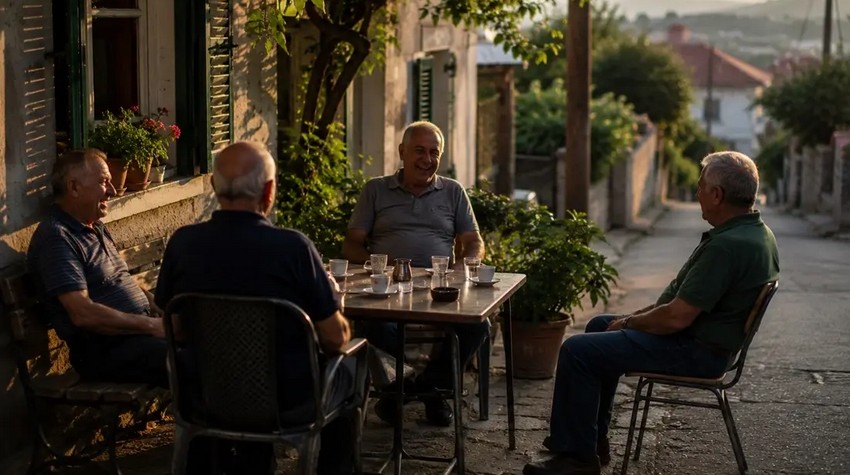
And
almost every time, the same scene unfolds: people sitting outside their homes,
watching life pass by. Without a special reason. Without a plan. Without the
need to turn the moment into content.
While
the Western world now organizes workshops on slow living, digital detox
programs, and mindful retreats that cost as much as luxury vacations, the
Balkans still have people who simply pull a chair outside at dusk and talk for
hours with no purpose at all.
And
perhaps that is exactly why this part of the world has managed to preserve
something the rest of the planet has almost completely lost.
THE LAST LUXURY THAT CANNOT BE BOUGH
In
many Balkan towns and villages, the old evening ritual still survives. Streets
become living rooms. Neighbors step outside as soon as the sun begins to set.
Someone serves coffee in small cups, someone pours rakija, someone brings
cherries or sunflower seeds wrapped in newspaper.
Children
ride bicycles between parked cars. Dogs sleep in the middle of the street.
Somewhere in the background, a television can be heard playing inside a house
that nobody is really watching.
Time
slows down. At first glance, nothing is happening. But that is precisely the
point.
Because
the greatest luxury of modern life may no longer be a private jet or a
five-star hotel. Perhaps the greatest luxury today is having enough peace to
sit outside your home without feeling like you are wasting time. Perhaps the
greatest luxury is having a neighbor you can casually say to: “Come, sit for a
while.”
THE BALKAN
ART OF CONVERSATION WITHOUT A PURPOSE
The
Balkans have never been particularly efficient. Trains run late. Coffee lasts
too long. People stop in the middle of the street just to talk.
And
maybe that is why the region remained immune for so long to the obsession with
productivity that swallowed the rest of the world.
Here,
conversations still happen without a clear reason or an agenda. People spend
hours talking about the weather, sports, neighbors, politics, children, old
times, or something completely meaningless.
And
nobody asks: “What’s the point?”
In the
Balkans, the point is often that there is no point at all.
In a
world constantly demanding results, goals, and optimization, that kind of
purposeless conversation has become almost a revolutionary act.
THE SLOWNESS THE WORLD IS TRYING TO RELEARN
Today,
cities like London, Copenhagen, and Los Angeles organize breathing workshops,
silence retreats, and expensive wellness programs where people are taught how
to spend a few hours without looking at their phones.
Meanwhile,
in the Balkans, there are still people who have spent every evening sitting
outside their homes for thirty or forty years without ever imagining it should
become a wellness concept.
It is
not a trend. It is not therapy. It is not a lifestyle strategy.
It is
simply life.
Of
course, the Balkans are changing too. There are fewer chairs outside homes than
before. Fewer spontaneous conversations. Younger generations look at phones
more often than they look at neighbors. Streets are quieter now.
But
the ritual has not disappeared.
There
are still summer evenings when someone shouts across the street: “Come over for
coffee.”
And
that “coffee” often lasts three hours.
PEOPLE WHO STILL KNOW HOW TO BE PRESENT
Perhaps
that is what makes these small Balkan scenes so moving. The people sitting
outside their homes are not trying to escape life. They are completely inside
it.
They
are not chasing experiences. They are not documenting happiness. They are not
turning everyday life into a performance.
They
simply sit. Watch the street. Greet passersby. Share silence long enough for it
to stop feeling uncomfortable.
At a
time when loneliness has become a global epidemic and social media has replaced
real human connection, those plastic chairs outside Balkan homes may represent
the final remains of a slower and more humane world.
A
world in which people did not need to go on a retreat to find peace.
It was
enough to bring a chair outside.

Join our
Viber Community
FROM THE FIELDS OF GLAMOČ TO TABLES ACROSS THE REGION: A POTATO WITH A NAME OF ITS OWN
WHERE TO GO FOR A MINI BREAK FOR TWO FOR JUST BAM 69

3 GREAT WEEKEND GETAWAY IDEAS IN REPUBLIC OF SRPSKA
TREBINJE’S TOURISM OFFER PRESENTED AT SARAJEVO TOURISM FAIR
BANJA LUKA HONEY DAYS: A SWEET CELEBRATION OF LOCAL TRADITION
GRADIŠKA INNOVATOR RECEIVES OFFICIAL SUPPORT FOR INNOVATIVE DIGITAL PROJECT
GAT NEAR GACKO EMERGES AS A NEW TOURIST ATTRACTION: NEW TRAILS, VIEWPOINTS AND REST AREAS
.jpg)
WHAT IS BEING BUILT IN SUTJESKA NATIONAL PARK?

EVERYONE IS INVITED: CHARITY HIKE ON KOZARA MOUNTAIN IN SUPPORT OF JELENA
BANJA LUKA’S YOUNGEST RESIDENTS SHOW THAT KINDNESS HAS NO AGE

 The situation at the border crossings