COULD A CHURCH GRAVEYARD IN BUKOVAČA HIDE THE OLDEST “COSMIC DISC” IN KRAJINA?
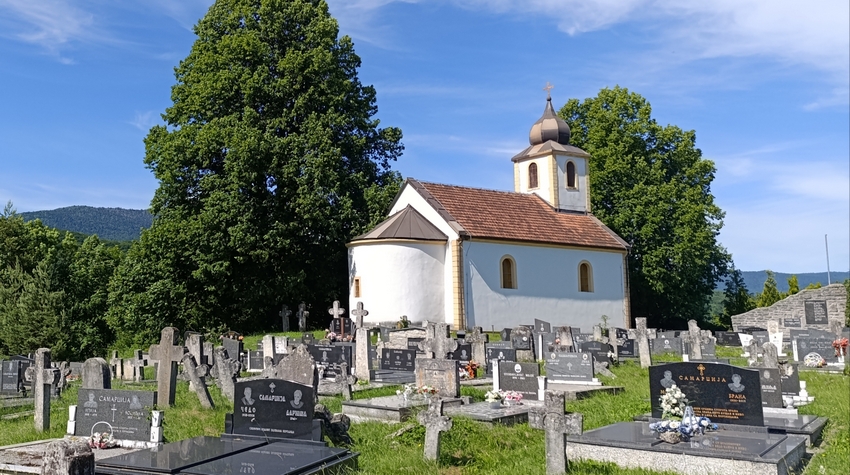
Among the stone slabs removed from the floor of the church in Bukovača, near Bosanski Petrovac, during recent restoration works, an intriguing archaeological mystery has emerged.
The
carefully carved square ambo, measuring approximately 80 centimetres on each
side, features remarkably precise geometric ornamentation. Its design raises
questions about the age of the sacred site and whether the stone could preserve
evidence of a much older Christian tradition than previously documented.
PERFECT
GEOMETRY OF A “COSMIC DISC”
The
composition appears to have been created according to a carefully calculated
geometric scheme, using a compass and ruler rather than rough, improvised
carving techniques.
A
narrow outer stone frame, approximately two centimetres wide, surrounds a
central celestial circle that appears to “float” within the square without
touching its edges. Such a contrast between the earthly square and the heavenly
circle can be interpreted through the symbolism of early Christian cosmology,
in which the circle represented perfection and the heavenly realm.
THE
CODE AT THE CENTRE: FROM FOUR TO EIGHT
At the
centre of the composition is a small circle surrounded by a precisely carved
groove. Four large petals emerge from this central motif, potentially
symbolising the Four Gospels as well as the four cardinal directions.
Between
the main petals, the carver added four pairs of curved leaf-like elements,
positioned diagonally at approximately 45 degrees. The resulting rotation
creates a visual transition from the fourfold structure to an eight-pointed
composition.
The
overlapping axes of the straight and diagonal crosses create an intriguing
eight-pointed Christian motif, which can be interpreted as a symbol of eternity
and resurrection.
CENTURIES
OF FOOTSTEPS, NOT WEATHERING
One of
the most remarkable features of the stone is the condition of its relief.
Rather than showing the rough deterioration that might be expected from
prolonged exposure outdoors, the edges of the petals and leaves appear smooth
and slightly worn.
This
could indicate prolonged human contact and centuries of foot traffic.
According
to the historical interpretation surrounding the site, the stone may have been
used inside a succession of places of worship — potentially including an early
Christian or Late Antique basilica, a later wooden church, and eventually the
masonry church built in the 19th century.
The
church was destroyed in 1941, but the surviving stone may preserve traces of a
much older sacred landscape.
A CLUE TO KRAJINA’S EARLY CHRISTIAN PAST?
The
comparison with nearby medieval monuments makes the Bukovača stone particularly
interesting. The medieval church of Panađur in Kolunić, generally associated
with the 14th century, reflects a much more modest and rustic architectural
tradition.
By
contrast, the geometric sophistication of the Bukovača slab could point toward
an earlier artistic tradition.
If
archaeological and epigraphic research were to confirm a Late Antique or Early
Byzantine date, the discovery could significantly deepen our understanding of
the history of Christianity in the Bosanski Petrovac region.
For
now, the stone remains an archaeological enigma rather than definitive proof of
a 1,500-year-old uninterrupted Christian tradition.
But
its unusual geometry, carefully planned symbolism and signs of prolonged wear
make it a remarkable object — and potentially an important piece in the still
incomplete story of Krajina’s ancient past.

Join our
Viber Community

WHAT IS HUMAN CREATIVITY WORTH IN THE AGE OF ARTIFICIAL INTELLIGENCE?
.jpg)
BOSILJKOVANJE 2026: WHERE TRADITION BRINGS PEOPLE TOGETHER

A JOURNEY BACK IN TIME ON FOUR WHEELS – CLASSIC CARS TAKE OVER THE STREETS OF TREBINJE
AUTUMN PHOTO WALK THROUGH ZVORNIK THROUGH THE LENS OF ZORANA DRAGUTINOVIĆ

NEW TAXI FARES COME INTO EFFECT IN BANJA LUKA

TIPPING AROUND THE WORLD: WHERE IT'S EXPECTED AND WHERE IT'S CONSIDERED RUDE
BANJA LUKA INCREASINGLY POPULAR WITH VISITORS FROM SERBIA

“THE POKONDIRENA TIKVA” TO OPEN 97TH THEATRE SEASON IN BANJA LUKA

CRISPY APPLE AND CINNAMON PASTRIES: AN EASY AUTUMN TREAT
DERVENTA TO HOST THE 17TH EVENING OF SPIRITUAL MUSIC


 The situation at the border crossings