THIS IS THE PLACE WHERE THE FIRST BOOK IN BOSNIA AND HERZEGOVINA WAS PRINTED
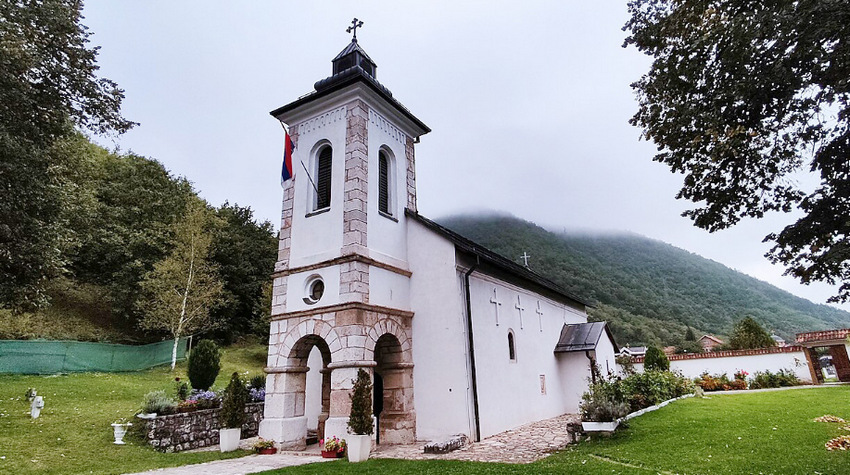
In the history of Serbian literacy and culture in Bosnia and Herzegovina, few places carry the significance of Sopotnica near Goražde. Hidden in the Drina River valley, this monastic complex was more than a spiritual center — it became the birthplace of the first printed book in Bosnia in the early 16th century. At a time when the written word was still bound to manuscripts, printing emerged in Sopotnica, opening a new chapter in the cultural history of the region.
The
Church of St. George in Sopotnica was built in 1446 as the endowment of Duke
Stefan Vukčić Kosača, one of the most powerful figures of medieval Bosnia and
Herzegovina. This is not an assumption, but a fact carved in stone.
A
marble inscription, preserved through centuries, reads:
“In
the year 1446, I, the servant of Christ God, Lord Duke Stefan, raised the
temple of the holy great martyr of Christ, George, praying to him to intercede
for me, a sinner, before my Lord Christ.”
This
inscription is not merely a founder’s message, but a first-rate historical
document. It speaks of the time, authority, and spirituality of an era, while
also testifying to the continuity of the Orthodox tradition in this region.
By the
15th and 16th centuries, additional inscriptions appeared on the church walls,
confirming that Sopotnica was not only a храм but also a monastery. This
implies the existence of an organized monastic brotherhood, which would later
prove to have not only a spiritual, but also a cultural role.
Sopotnica in Ottoman Defters
The
story gains further weight through Ottoman census records known as defters. In
the earliest registers of the Bosnian Sanjak from 1468 and 1469, as well as the
nominal census of the Herzegovina Sanjak from 1477, Sopotnica is clearly
mentioned.
These
sources reveal something crucial — the monastery possessed land and income,
indicating that it was institutionally recognized and economically sustainable
even under Ottoman rule. In a time of major political change, Sopotnica did not
disappear; it endured.
That
continuity proved essential. It enabled the conditions for something
unprecedented in the region at the beginning of the 16th century — the
establishment of a printing house.
The Birth of the Goražde Printing House
A
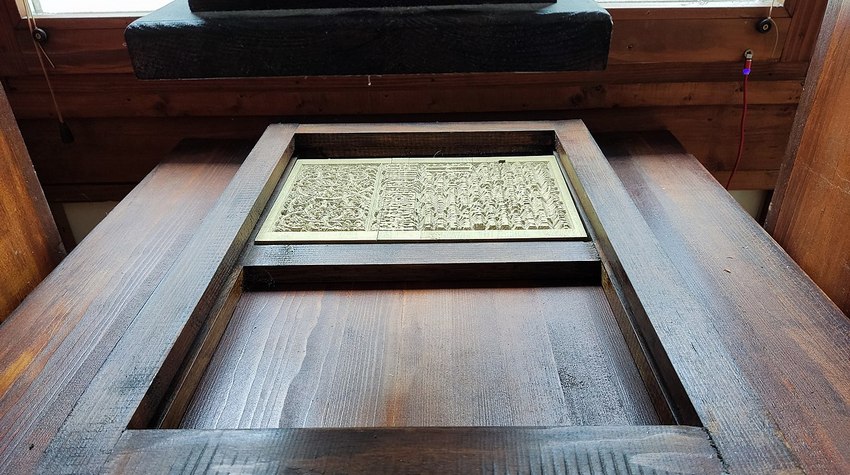
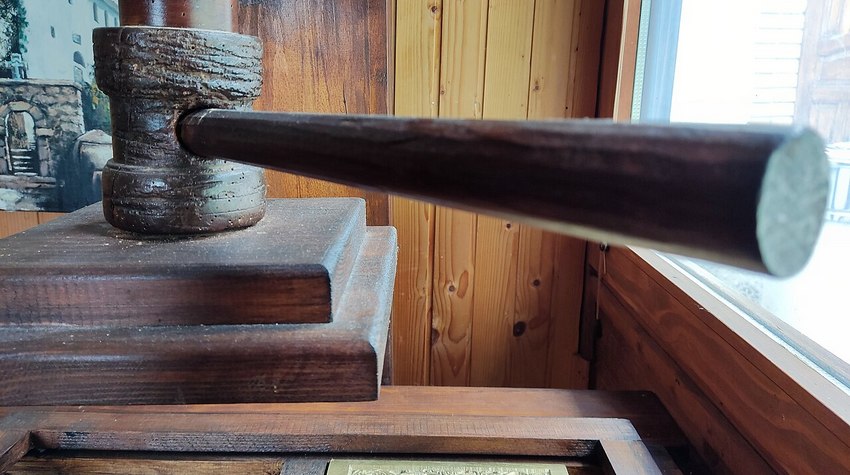
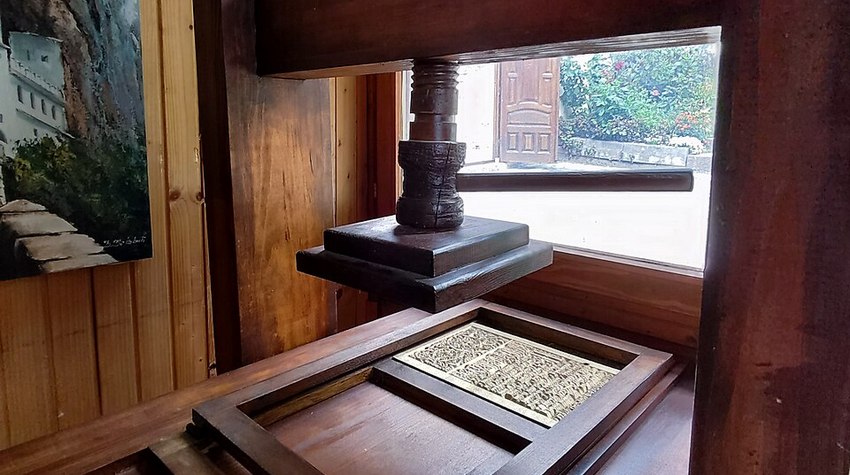
major turning point came in the early 1500s, when the first printing house in
Bosnia — known as the Goražde Printing House — was established in Sopotnica.
Its founder was Božidar Goraždanin, a prominent merchant who understood the
importance of the new technology.
He
sent monks, the Ljubavić brothers, to Venice — then a major center of printing
— to learn the craft and acquire equipment. It was no small undertaking.
The
printing house began operating in 1519, when the “Službenik” (Service Book) was
printed — the first printed book in Bosnia. This was followed by the “Psalter
with follow-up services” in 1521, and a “Prayer Book” in 1523.
These
were no ordinary books. They were printed in Cyrillic, in the Church Slavonic
language of the Serbian recension, with highly developed typography. Notably,
they were printed in two colors — black and red — typical for liturgical books
of the time.
Their
ornaments, initials, and text structure reveal a strong influence of manuscript
tradition. Printing did not replace manuscript culture — it transformed it into
a new form.
The
work was led by hieromonk Teodor, the chief printer and editor, alongside
deacon Radoje, who is mentioned in the final notes. They are considered the
first known printers on the territory of Bosnia.
Why the Printing House Disappeared
Despite
its importance, the Goražde Printing House had a short lifespan. Its operations
ceased shortly after 1523. The reasons were likely economic and political — the
Ottoman Empire did not actively support such ventures, and the market remained
limited.
However,
the story did not end there.
The
printing tradition continued through the descendants of Božidar Goraždanin, who
relocated the press to Wallachia, to Târgoviște (in present-day Romania), where
they resumed printing activities in the mid-16th century.
This
makes Sopotnica not only the place where printing began in Bosnia, but also a
starting point for the spread of printing culture across the Balkans.
Within
the monastery itself, the tradition of literacy persisted. In 1550, a Four
Gospels manuscript was copied in Sopotnica, proving that even after the
printing house ceased operations, the preservation of the written word
continued.
A Legacy That Endures
The
Goražde Printing House was the first in Bosnia and one of the earliest in the
Balkans. Its importance lies not only in the books it produced, but in its role
as a bridge between medieval tradition and the modern age.
From
1523 until the 19th century, Bosnia had no new printing house. Printing
reappeared only in Sarajevo during the rule of Osman Pasha in the first half of
the 19th century.
Thus,
in the endowment of Duke Stefan Kosača, the first printing house and the first
printed book in Bosnia were created. Today, Sopotnica stands as a quiet yet
powerful testament to Orthodox spirituality, literacy, and the historical
continuity of this region.

Join our
Viber Community

DAYS OF SEMBERIJA IN AUSTRIA: CULTURE, TRADITION AND LOCAL PRODUCTS PRESENTED TO AUSTRIAN AUDIENCES

BANJA LUKA BOOK FAIR 2026 OPENS TODAY
THE PEOPLE PROTECTED THE SACRED ICON, BELIEVING IT WAS PROTECTING THEM: THE STORY OF THE ČAJNIČE KRASNICA

APPEAL FOR HELP: BLOOD DONORS URGENTLY NEEDED FOR NATAŠA ĆEJIĆ IN BANJA LUKA

NEW GENERATION OF STUDENT THEATRE MEMBERS TAKES THE STAGE
APPEAL FOR HELP: BLOOD DONORS URGENTLY NEEDED FOR NATAŠA ĆEJIĆ IN BANJA LUKA

DEJAN KOKANOVIĆ CONQUERS 336 KM THROUGH THE ITALIAN ALPS

OKTOBERFEST KICKS OFF IN MUNICH, EXPECTING 6.5 MILLION VISITORS
DAYS OF SEMBERIJA IN AUSTRIA: CULTURE, TRADITION AND LOCAL PRODUCTS PRESENTED TO AUSTRIAN AUDIENCES

AUTUMN FRUITS AND HONEY FESTIVAL COMES TO BANJALUKA


 The situation at the border crossings