ŽIVKO SAVIĆ WROTE AN EXTRAORDINARY LIFE STORY ON TWO WHEELS
When cyclist Živko Savić from Srbac recently crossed the finish line first at the international cycling race "Grand Prix Mohács" in Hungary, few people knew that behind his success was not a typical sporting career, but a hobby that gradually led him to the top of the podium.
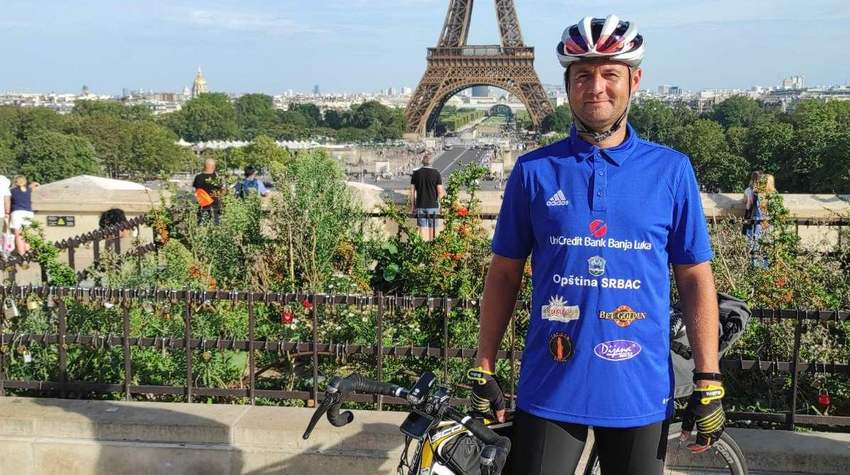
For years, Savić worked in the banking sector,
and he did not buy his first bicycle until his thirties, looking for a way to
escape a sedentary lifestyle and everyday stress. Today, he is a champion of
Republika Srpska, a member of the Bosnia and Herzegovina national team and one
of the country's leading cyclists.
SUCCESS IN HUNGARY
His victory in Hungary brought BSK Banja Luka,
the club he represents, its first international victory in ten years, proving
that top-level results can be achieved even when a sporting journey begins as a
simple hobby.
Although he had played football from the age
of six and represented Srbac-based Sloga, life eventually took him in a
different direction. Health problems, work and everyday responsibilities kept
him away from sport, while a major turning point came during the COVID-19
pandemic.
"I worked in banking, which is a very
demanding and stressful job. I spent the whole day in front of a computer and
dealing with clients. I realized that I was missing physical activity, and
cycling proved to be an ideal way to relieve both physical and mental
stress," Savić said.
His first bicycle was a used trekking model
designed for touring. He started with rides of around ten kilometres after
work, then 20 kilometres, gradually increasing the distance. His first serious
challenge was a ride to the Osovica Monastery and back, covering around 50
kilometres, which at the time seemed like a major achievement.
THE TURNING POINT
The decisive moment came when his colleague
Ranko Davidović persuaded him to take part in a 200-kilometre brevet marathon.
At the start, Savić was the only participant riding a trekking bicycle, while
everyone else was using professional road bikes.
"There were cramps, pain and exhaustion,
but we encouraged each other all the way to the finish. I completed the course
in 11 hours, within the time limit, and that was when I realized I could
achieve much more than I had thought. After that day, I wanted a better bicycle
and a more serious approach to training," Savić recalled.
The first successes soon followed. At the
Bosnia and Herzegovina Road Cycling Championships, he won a bronze medal, which
he considers one of the most important achievements of his career. He was
subsequently called up to the Bosnia and Herzegovina national team and competed
in the "Tour of Bosnia" race.
This year, Savić won the Republika Srpska
championship titles in the time trial and elite categories.
HOLDING HIS OWN AGAINST THE ELITE
Savić also demonstrated that he can compete
with world-class cyclists at a recent race in Croatia, where he went
head-to-head with seven-time Guinness World Record holder Ryan Collins.
Although the American had significantly better
equipment and an entire support team, Savić finished just eight minutes behind
him, leaving a strong impression on the organizers and fellow competitors.
"He was riding a special bicycle, while I
was competing on a regular road bike. He tried to break away throughout the
race, but I managed to stay with him, which even prompted his team and the
organizers to ask who I was. In the final hour, however, he launched a decisive
attack that I could not follow, and he eventually won by a small margin,"
Savić said.
One of the most difficult moments of Savić's
career came last year, when, just as he was close to earning the prestigious
Randonneur 10,000 title, he suffered a serious crash and fractured his
collarbone and three ribs.
To earn the title, Savić had to complete a series
of demanding brevets and marathons within a four-year period.
"After the crash, I was convinced that
everything was lost and that I would have to start the entire process all over
again. However, with the help of doctors, I managed to recover in just one
month and complete the required 400-kilometre marathon. That earned me this
recognition, which I am particularly proud of," Živko said.
THE OTHER SIDE OF THE SPORT
Behind every success lies another side of
professional cycling. A high-end road bicycle can cost up to €15,000, while
specialised time-trial bikes can reach €20,000. On top of that come expensive
equipment, power meters, helmets, travel expenses and race entry fees.
"I finance most of it myself, with
occasional support from sponsors. Because of that, I had to miss several major
international competitions, including last year's event in Australia. My
participation in the World Championships in Japan this August is also
uncertain. Nevertheless, I plan to somehow raise the funds needed to compete at
the European Championships in Italy, scheduled for October 3 and 4. Another
cyclist from our region has also qualified, so we will try to organize the trip
together," said Savić, who at one point also competed for the BN Cycling
Team from Bijeljina.
FAMILY SUPPORT
Živko Savić draws his greatest strength from
his family. His wife and children are his biggest supporters, and he is
especially proud that his sons recently took part in a children's cycling race,
finishing third and fourth.
"I want to encourage as many young people
as possible to get on a bicycle by setting an example myself. One such example
is Bojan Nježić from Srbac, who trains with me at the club and is achieving
fantastic results in the junior category. This proves that we have talented
athletes, but more investment in cycling is needed at both the entity and state
levels," Savić emphasized.
From buying his first used trekking bicycle in
his thirties to becoming a champion of Republika Srpska and an international
race winner, Živko Savić's story is a reminder that it is never too late to
discover a passion – and that sometimes, a simple hobby can become a remarkable
journey.

Join our
Viber Community



 The situation at the border crossings