OHRID: A BALKAN JEWEL OF HISTORY AND NATURE
Ohrid, located in the southwestern part of North Macedonia on the northeastern shore of Lake Ohrid, stands as one of the country’s most important tourist destinations. Together, the city and the lake attract visitors from around the world, drawn by their unique blend of history, culture, and natural beauty. Due to its remarkable number of churches, Ohrid is often referred to as the “Jerusalem of the Balkans.”
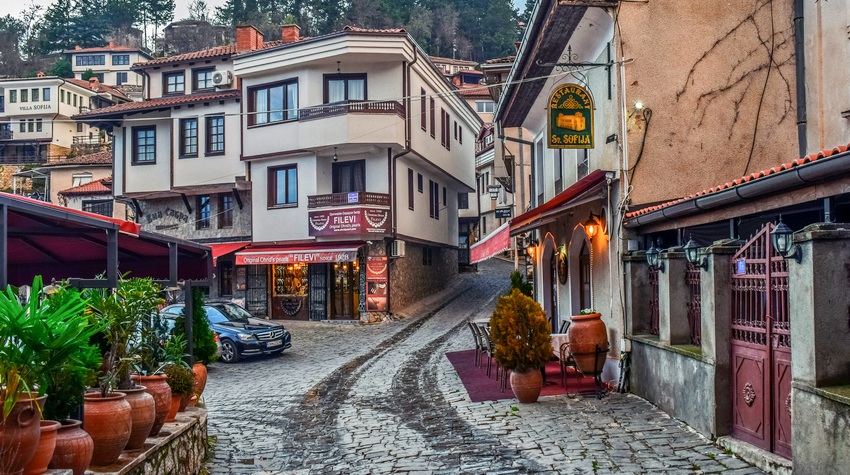
The
city is also known as the “City of Light,” a literal translation of its ancient
name, Lychnidos.
Lake
Ohrid itself is considered a true natural wonder. It is home to more than 200
endemic species of plants and animals, including algae, zooplankton, fish,
snails, and crustaceans, earning it the nickname “Europe’s Galápagos.” Experts
estimate that the lake formed around four million years ago, preserving species
that have long disappeared elsewhere in the world.
This
extraordinary biodiversity is one of the reasons why UNESCO placed Lake Ohrid
on the World Heritage List in 1980, recognizing it as one of Europe’s most
significant biological reserves.
Situated at an altitude of 693 meters, the lake stretches 30.8 kilometers in length and reaches a maximum depth of 289 meters. It is bordered by Galičica to the east and Jablanica to the west.
Along
its shores lie the cities of Ohrid and Struga in North Macedonia, as well as
Pogradec in neighboring Albania. Known for its deep blue color, warm waters,
and vast surface area of 358 square kilometers, the lake is often described as
Macedonia’s freshwater sea. It is a popular destination for swimming and
fishing, and in certain areas, divers can even discover archaeological remains
dating back some 3,000 years.
Lake
Ohrid is fed by numerous underwater springs, as well as sources near the
Monastery of Saint Naum and at Studenište in Ohrid. Much of its water
originates from underground flows connected to Lake Prespa, which lies at a
higher elevation. Several rivers and streams from the Ohrid basin also flow
into the lake.
Seventeen
species of fish inhabit the lake, including the well-known Ohrid trout,
letnica, and belvica—species found nowhere else in the world. Alongside eel,
chub, carp, and barbel, the lake is also home to a small fish called plašica,
whose scales are used to produce the famous Ohrid pearl.

Join our
Viber Community
TRAVELING BY CAMPERVAN FOR THE FIRST TIME? HERE’S WHAT YOU SHOULD KNOW BEFORE YOU GO

NEW RAIL LINK BETWEEN REPUBLIKA SRPSKA AND SERBIA: DAILY TRAIN SERVICE FROM ZVORNIK TO BELGRADE
‘DRŽAVNI POSAO’ CREW FILMS NEW PROJECT IN TREBINJE

SEE SRPSKA RECEIVES CHARTER FROM BANJA LUKA TOURIST ORGANIZATION

GALIJA TO CELEBRATE MAJOR ANNIVERSARY IN BANJA LUKA
SEE SRPSKA RECEIVES CHARTER FROM BANJA LUKA TOURIST ORGANIZATION
NEW RAIL LINK BETWEEN REPUBLIKA SRPSKA AND SERBIA: DAILY TRAIN SERVICE FROM ZVORNIK TO BELGRADE

BANJA LUKA BOOK FAIR 2026 OPENS TODAY
DAYS OF SEMBERIJA IN AUSTRIA: CULTURE, TRADITION AND LOCAL PRODUCTS PRESENTED TO AUSTRIAN AUDIENCES

FROM EUROPEAN STAGES TO HER HOMETOWN: JOVANA RALJIĆ BRINGS VIVALDI TO BANJALUKA


 The situation at the border crossings