WESTERN BALKANS CREATIVITY TAKES CENTRE STAGE IN EUROPE
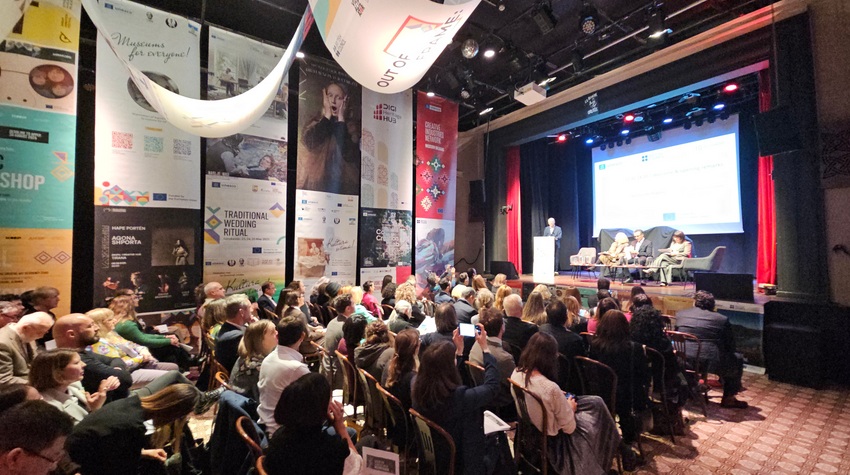
The FLOW / TOK exhibition, bringing together creative initiatives and cultural projects from across the Western Balkans through art, has been presented in Brussels as part of an international event showcasing the results of the four-year Culture and Creativity for the Western Balkans (CC4WBs) programme.
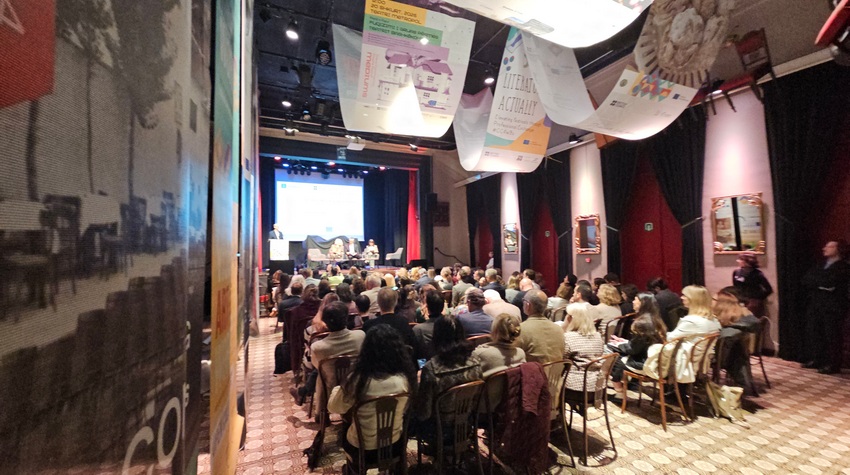
Organised
by CIM Forum at the invitation of UNESCO, the event took place at Le Bouche à
Oreille, bringing together representatives of European institutions,
international organisations, artists and professionals from the region's
cultural and creative sectors.
The
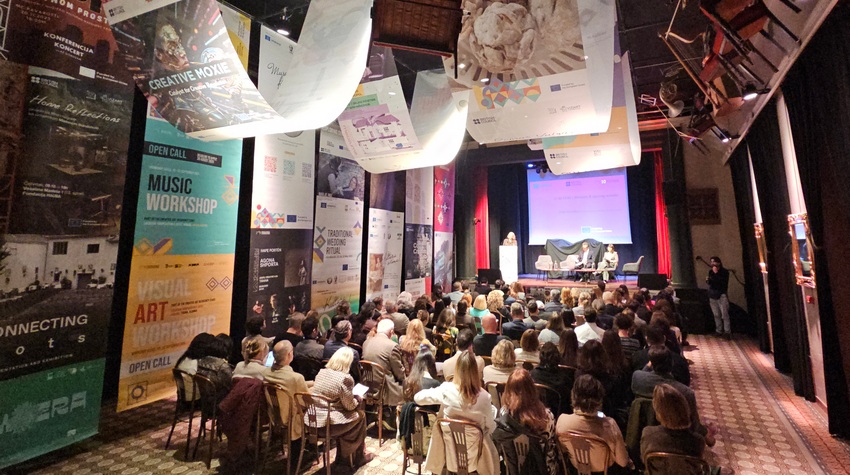
centrepiece of the exhibition was a monumental spatial installation created by
artist and curator Marija Džoganović, a member of the CIM Forum team and Dean
of the Faculty of Visual Arts at the University of Mediterranean.
The
installation brings together visual materials from artistic projects, creative
initiatives and regional partnerships supported through the CC4WBs programme,
creating a unified artistic presentation of the diversity and potential of the
Western Balkans' creative scene.
The
graphic integration of existing posters and visual materials produced by grant
beneficiaries, as well as their preparation for the exhibition, was undertaken
by CIM Forum designer Emilija Jovančević Čičić.
ART THAT TRANSFORMS WITH THE MOVEMENT OF VISITORS
Following
its presentation on the historic city walls of Kotor during this year's CIM
Forum, the exhibition arrived in Brussels with a new spatial and artistic
interpretation, adapted to the architecture of its new setting.
Through
suspended structures and transparent materials, Džoganović established new
relationships between different parts of the interior, creating visual
partitions that connect rather than separate the space.
One of
the exhibition's distinctive features is its dynamic character: the
installation changes depending on how visitors move through it, revealing new
perspectives and visual relationships.
"Space
offers me, as an artist, possibilities that go beyond the boundaries of a
painting canvas. I do not see it merely as a place where an artwork is
installed, but as an active collaborator in the process of its creation,"
Džoganović explained.
She
noted that one of the main challenges of the Brussels presentation was finding
harmony with the existing architecture without imposing an entirely new
identity on the space.
The
concept was to create a wall that does not close off the interior and passages
that simultaneously become part of the exhibition itself. In this way, the
movement of visitors became an integral element of the FLOW / TOK artistic
concept.
THE WESTERN BALKANS AS PART OF EUROPE'S CULTURAL LANDSCAPE
The
exhibition's presentation in Brussels carries particular significance in a city
where different cultures, languages and identities meet.
This
multicultural environment provided an ideal setting for showcasing authentic
visual expressions from the Western Balkans. Brought together in a shared
installation, they establish new connections while retaining their individual
identities.
"I
would like the Western Balkans to be seen through this exhibition not as
Europe's periphery, but as a region of intense creative activity that
participates equally in shaping contemporary European culture," Džoganović
said.
The
exhibition therefore goes beyond a conventional presentation of the results of
an international programme. It offers an artistic interpretation of
cooperation, mobility, knowledge exchange and the growing connections between
cultural and creative communities across the region.
CIM FORUM STRENGTHENS INTERNATIONAL PARTNERSHIPS
The
Brussels presentation marks another milestone in CIM Forum's cooperation with
UNESCO, the British Council and the Italian Agency for Development Cooperation
(AICS), building on joint programme activities previously organised in Kotor.
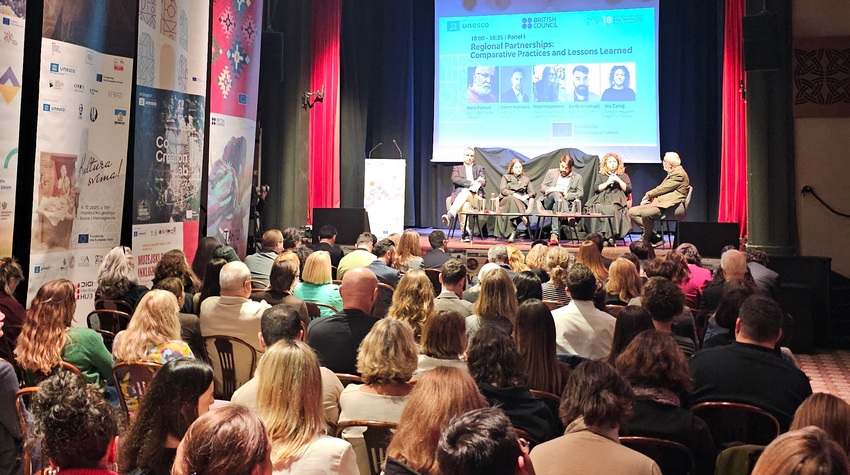
Alongside
the exhibition, CIM Forum also contributed to the Management in Arts panel,
which addressed the sustainability of cultural projects, the development of
creative industries and opportunities to transform regional and international
cooperation into long-term partnerships.
The
international event featured an exhibition, discussion sessions and a music
programme, including a performance by the Sarajevo-based artistic collective
Helem Nejse.
Participation
in Brussels represents an important step in strengthening CIM Forum's
international profile as a regional platform connecting creative industries,
media, art and contemporary cultural practices. It also contributes to
promoting Montenegro's creative scene within the wider European cultural
context.
The
Culture and Creativity for the Western Balkans (CC4WBs) programme is funded by
the European Union and jointly implemented by UNESCO, the British Council and
the Italian Agency for Development Cooperation (AICS). Its main objectives are
to strengthen the cultural and creative sectors, encourage regional cooperation
and foster intercultural dialogue.

Join our
Viber Community
WESTERN BALKANS CREATIVITY TAKES CENTRE STAGE IN EUROPE
BANJALUKA INCREASINGLY ATTRACTIVE TO YOUNG TRAVELLERS FROM AROUND THE WORLD

WORLD TOURISM FILM AWARDS TO BE HELD IN AFRICA FOR THE FIRST TIME
MOMS PAINT, KIDS PLAY - A UNIQUE CONCEPT FOR SOCIALIZING AT A BANJALUKA PLAY CENTER

ONE SKI PASS TO CONNECT THE REGION'S MOST POPULAR WINTER RESORTS
ONE SKI PASS TO CONNECT THE REGION'S MOST POPULAR WINTER RESORTS
SUTJESKA NATIONAL PARK MANAGEMENT PREPARES NEW TOURISM OFFER: WILDLIFE TO BE “HUNTED” WITH CAMERAS
WHAT BROUGHT A FORMER NBA CHAMPION BACK TO THE REPUBLIC OF SRPSKA?
CAMP EDEN: ADVENTURE AND RELAXATION ON THE BANKS OF THE DRINA, TARA AND PIVA RIVERS

BREATHE DEEPLY IN THE SOUTH OF REPUBLIKA SRPSKA: CLEAN AIR AND THE SCENT OF IMMORTELLE AND SAGE

 The situation at the border crossings